
 (Photo : IANS/Gwyneth Paltrow/insta) Los Angeles, September 20 (IANS) Hollywood actress Gwyneth Paltrow has shared that she and Chris Martin were determined to "stay a family" after they parted ways. The actress and the Coldplay frontman, who share Apple, 22, and 20-year-old Moses together, grabbed headlines when they used the phrase "conscious uncoupling". The couple announced their marriage was over in 2014. The 53-year-old actress has now explained the origins of the viral term and how she and the Yellow hitmaker had sought expert help on how to make the transition as smooth as possible for their kids. She appeared on the ‘Friends Keep Secrets’ podcast, and said, “We really sat down and thought, like, is there a way that we could do this? I talked to all my friends who came from a divorced household and I said, ‘Tell me what was the worst thing? Like, what do you feel you have scars from to this day?’”. She went on, “They said the worst part was like my parents, you know, my dad used to drop me off at the end of the driveway. Like it was so tense at my birthday parties, you know, they never ate dinner in the same room until my college graduation, and it caused me so much pain. So I was like, how could we not do that?”. The actress further mentioned that she wanted her kids to grow up in a situation where “you’re all having dinner at the same table” after a graduation, and so she and Chris consulted a therapist. She continued, “So Chris and I had this therapist that was really brilliant, and he sort of introduced us to the concept and we just made a commitment to really put the kids first and so what that meant was to stay a family even though we weren’t a couple”. However, she said that things weren't always easy and while they committed to have brunch as a family of four every Sunday when they left London for Los Angeles, there was one particular occasion Gwyneth felt “might go really off the rails”. “It was getting tense and we looked at each other and we went outside on the front porch and we’re like, ‘Let’s just not. Let’s just, you know, let’s just not’, and we just hugged and we were like, ‘Okay, fist bumped and then we went to brunch”, she added. The actress is now married to Brad Falchuk. She earlier told Amy Poehler on her ‘Good Hang’ podcast earlier this year, “I was supposed to do a movie at one point and it was like right after the conscious uncoupling thing with Chris, and there was a lot of harsh stuff in the press”.“I think the distributor was like, this might be too hot to touch. So that was great because I was getting a divorce and then I got fired. So it was so awesome”, she added. Gwyneth Paltrow, Chris Martin were determined to "stay a family" after divorce | MorungExpress | morungexpress.com: |
Gwyneth Paltrow, Chris Martin were determined to "stay a family" after divorce (2026-09-22T12:57:00+05:30)
How to protect yourself from misinformation in the digital world (2026-09-15T10:34:00+05:30)
 UW Professor Cindy Aden greets attendees. With the exponential growth of social media, online news sources (credible and otherwise), chat groups, and artificial intelligence (AI), more and more people are using the internet as their primary source of news and information. While much of this information is credible, much is not. And emerging tools like AI are making it increasingly difficult to separate the accurate from the harmful. In an effort to help local consumers of information sort through this, the Friends of the Edmonds Library offered a Tuesday afternoon program aimed at helping us become more savvy in identifying and acting on misinformation. Led by Jason Young and Cindy Aden, both representatives from the University of Washington’s Information School, the session focused on the important role that emotion plays in misinformation, and how to improve and build your personal digital acumen so you are better prepared to explore online. “One distinction I want to make right off the bat is the difference between misinformation and disinformation,” began Aden. “It comes down to where the information comes from and why. Misinformation is inaccurate information that may be unintentional. Disinformation on the other hand is formulated to intentionally deceive and manipulate. Sometimes it’s difficult to tell these apart. Knowing the source can help, but it’s not foolproof. But one thing is for certain: with the growth in social media, it is much easier to spread misinformation. “The concept of alternative facts is almost mind-boggling,” she continued. “Folks can say whatever they want, regardless of whether it has any basis in fact. It allows them to stay within their own realm of what they think should be true. This leads to an effect we call conformation bias where you only look for information that supports your chosen beliefs and at the same time you ignore information that doesn’t support your point of view.” She went on to explain that part of confirmation bias is that our brains are always looking for a more efficient way to interpret information and have a natural bias to maintaining what we already believe. It’s simply easier for the brain to say, “oh yeah, this fits with what I already believe” than to say, “oh wait, this fact doesn’t fit so I need to re-examine and perhaps change my core beliefs.” In the latter case, your brain is forced to either reinterpret the new information to fit its chosen beliefs, ignore the new information, or – most difficult of all – change its core beliefs. “Our brain looks for familiar patterns, and it’s truly frightening to give these up,” she explained. “We want to find something safe and familiar. It’s extremely difficult for folks with deeply entrenched beliefs to change their minds.” Advertiser Content  And social media feeds this. One way is by using algorithms that in effect curate your information by looking for things similar to what you’ve looked for before and then presenting them to you. And the advent of new and more sophisticated techniques using AI and deep fakes adds to the problem of differentiating between what is real and what is not. “And for increasing numbers of folks, social media is their only source of information,” she added.  “So there’s the problem,” said Jason Young as he took over the session. “For the rest of today, we’ll be looking at what we can do about it.” He went on to explain that the two major drivers of the misinformation problem are changes in technology and a social shift that has resulted in many folks simply not wanting the truth anymore. They want to embrace false things because they’re more comfortable that way – that’s classic confirmation bias. “First technology,” he continued. “Today anyone with a cell phone and an internet connection can say anything they want and people on the other side of the world hear it instantly. AI can produce fake photos (remember when we used to say pictures don’t lie – we can’t say that anymore), and fake videos, where a misinformation purveyor can make politicians and officials – anyone really – look like and say whatever they want.”  Professor Jason Young explains how to sift through online information to separate the real from misinformation. Professor Jason Young explains how to sift through online information to separate the real from misinformation.He pointed out that this kind of misinformation targets not just your mind, but your emotions as well. By playing on emotions the misinformation purveyor hopes to get you to react more quickly than you should by confusing you and getting you to take action without thinking. “The classic example is getting a call from a grandchild in trouble who needs money right away,” he said. “The voice sounds right, and the kid knows your name, so you rush to the 7-Eleven, buy a cash card and give the number to the scammer without taking time to think it through. Only later you learn that the child’s voice was faked and your money is gone.” Young then presented a simple technique to raise media literacy and help you see through misinformation. It’s called SIFT – the S stands for stop; the I for investigate; the F for find other coverage; and the T for trace the information to the original source.  “Stop is the vital first step,” he explained. “When you find potentially suspicious information, don’t immediately act on it, share it or anything else. Next check out the source – ask yourself is there is a reason you should believe it, is it credible, is it something you’ve heard of before? If it smells funny, do a Google search on the source’s name. Then check the subject matter – Google is great for this too. Has anyone else reported on this? Can you find where the story originated? If an image is involved do a Google image search to see where else it’s been published.” He then provided an example from a real post on X (formerly Twitter):  “You see this, and it’s emotional, it’s scary,” he explained. “A zombie virus that poses a threat to humans, comes from Russia, and will be unleashed by climate change. Pushes lots of buttons, right?” But go back to SIFT. First check out the source, Buzzing Pop – is it credible, has any other news organization reported this? Check for other information about zombie viruses. Check the photo to see if it’s real, created, or from somewhere unrelated. “This will take you less than five minutes with Google,” he added. Young then took up how to detect false images and videos generated or altered by AI. “AI is getting better all the time,” he explained, “and it’s getting harder to see through it. At this time, deep fakes still have trouble with image backgrounds, eyeglasses, teeth and hair, so if these don’t look quite right, you’re likely dealing with a fake, but newer AI techniques are making it harder to tell.”  In the two images above, the girl on the left is real. But look at the man on the right. The hair doesn’t look natural, and the background is mottled. He’s a fake. “But our old SIFT technique still applies,” he concluded. “When you encounter something that seems odd, stop and take a moment to look closely. Is it asking you to do something weird? Is it trying to make you click on a link?” If you do a Google image search on a person’s face, it will give info on where that face has appeared before – if there’s no backstory, you’re likely dealing with an AI-generated fake. “The bottom line is to be careful. Remember that people have lied and hidden truths forever, but technology is making it so much easier and widespread.” he added. “Don’t share something (especially if it’s sensational and you just feel drawn to click it) on social media until you check the sources and do the research. Try to be aware of your own confirmation biases, avoid following clickbait, and don’t get pulled in by buzzwords and emotional content. The purveyors of misinformation are getting better all the time, but that doesn’t mean there isn’t a lot of good information out there, and little bit of thought and fact-checking will go a long way to helping you separate the good from the bad.”— Story and photos by Larry Vogel How to protect yourself from misinformation in the digital world |
India needs secure, interoperable, and technology-neutral critical communications architecture: Experts (2026-09-07T11:19:00+05:30)
 (File Photo/IANS) New Delhi, (IANS) Government, industry and global experts called for a secure, interoperable, and technology-neutral critical communications architecture at the Critical Communications India Conference that concluded on Thursday. Harinder Kumar, Secretary, TRAI, urged a coordinated push to ensure that interoperable critical communications capability reaches every intended user. Broadband India Forum (BIF), in association with the Critical Communications Association (TCCA) held the conference. “Critical communications is a complex ecosystem and the requirements differ for different kinds of disasters. India has made significant progress in strengthening public warning systems but the focus must now shift towards ensuring that these capabilities reach every intended user and continue evolving with technology," Kumar said. "We also need to understand why captive private networks have not yet scaled in the country and address the barriers to their adoption," he added. Kumar urged DoT, the Ministry of Home Affairs, disaster management agencies and telecom service providers to collaborate to build hardened telecom infrastructure in disaster-prone areas. The Conference brought together senior representatives from government, regulators, public safety and disaster management agencies, standards organisations and the global mission-critical communications industry. The conference focused on aspects of proof of concept, interoperability of networks and devices along with the evolution of the next generation of device ecosystems. It also focused on control centers and aspects related to backward compatibility with legacy devices along with the interoperability and implementation pathways for next-generation critical communications networks. Experts discussed whether India should have a dedicated BB-PPDR Network or should utilise the capacity of the existing operators’ commercial network. Participants stressed the importance of seamless interoperability, priority communications for first responders, operational resilience and extensive field testing to ensure that systems perform reliably in the worst of times. Participants deliberated the successful Proof of Concept undertaken by the state level police and public safety agencies in coordination with Directorate of Coordination Police Wireless (DCPW) at 6 different locations spread across different geographies and terrains and climatic conditions.An expert session emphasised the valuable operational learnings from extensive user trials, and the importance of continued stakeholder engagement to support future deployment. India needs secure, interoperable, and technology-neutral critical communications architecture: Experts | MorungExpress | morungexpress.com |
Counting on Fingers Really Helps Kids Improve Their Math Skills–By 40% New Study Shows (2026-09-07T11:16:00+05:30)
 By Yan Krukau via Public Domain on Pexels By Yan Krukau via Public Domain on Pexels22-08-2025, Some teachers consider finger counting a signal that youngsters are struggling with math, while others associate its use as advanced numerical knowledge. Now, new research is the first to show that children’s performance in arithmetic can show a “huge” improvement through the teaching of a finger-counting method. Swiss and French teams explored whether finger counting can help primary-school-aged children to solve math problems. They said adults rarely use their fingers to calculate a small sum, because such behavior could be attributed to cognitive impairments or “pathological difficulties” in math. But young children under age 8 who use their fingers to solve such problems may be seen as intelligent, probably because they have already reached a level that allows them to understand that a quantity can be represented by different means. The research aimed to determine whether children who don’t count on their fingers can be trained to do so, and whether such training would result in enhanced arithmetic performance. The study, published in the journal Child Development, focused on 328 five- and six-year-old children at kindergarten, mainly living in France, and tested their abilities to solve simple addition problems. The kindergarteners were recruited through their teachers, who voluntarily took part in the experiment, which included a pre-test, training held over two weeks, a post-test closely after the training’s end, and a delayed post-test. The results showed an “important increase” in performance between pre- and post-test for the trained children who did not count on their fingers originally—from 37% to 77% of correct responses—compared to non-finger users in the control group. Whether children who use finger counting are using it as an arithmetic procedure or understand something deeper about numbers will still need to be determined with future research. “Our findings are highly valuable because, for the first time, we provide a concrete answer to the long-standing question of whether teachers should explicitly teach children to use their fingers for solving addition problems,” said study leader Dr. Catherine Thevenot. “Finger calculation training is effective for over 75% of kindergartners,” she added. “The next step is to explore how we can support the remaining 25% of children who didn’t respond as well to the intervention.” Dr. Thevenot, of the Institute of Psychology at the University of Lausanne, Switzerland, says the study came about as a result of conversations with primary school teachers. “They often asked me whether they should encourage or discourage children from using their fingers to solve calculations. “Surprisingly, the existing research didn’t offer a clear answer, which left teachers understandably frustrated with my frequent response of ‘I don’t know.’ “This recurring question, coupled with the lack of concrete evidence, inspired me to investigate the issue myself. “When I first saw the results, I was amazed by the huge improvement in performance among children who didn’t initially use their fingers to solve the problems. “Before our intervention, these children were only able to solve about one-third of the addition problems during a pre-test. After training, however, they were solving over three-quarters of them. “This improvement truly exceeded my expectations,” said Dr. Thevenot. “The difference was striking, especially compared to the control groups, where gains were insignificant. “An important question now is to determine whether what we taught to children goes beyond a mere procedure to solve the problems. “In other words, we want to know whether our intervention led to a deeper conceptual understanding of numbers, specifically whether children better grasp how to manipulate the quantities represented by their fingers. “In fact, we have already started addressing this question and the initial results are very promising. However, we still need to carry out additional experiments to confirm that these improvements are indeed a direct result of our training program.” Counting on Fingers Really Helps Kids Improve Their Math Skills–By 40% New Study Shows |
Drew Barrymore reveals ‘50 First Dates’ was originally a ‘hardcore drama’ with different ending (2026-09-06T12:00:00+05:30)
 Mumbai, August 25 (IANS) Hollywood star Drew Barrymore has revealed that the iconic film “50 First Dates” originally had a far more dramatic ending than the romantic conclusion and that it was supposed to be a “hardcore drama”. Speaking to Brett Goldstein on her show The Drew Barrymore Show, the actress shared details about the film’s original script, which would have ended with her character Lucy and Henry going their separate ways before reconnecting years later. The conversation started with Goldstein telling the actress that 50 First Dates is one of his favourite films. Barrymore shared that Adam Sandler was present in the show the other night. Goldstein replied: “I love him. I think it is so beautiful, that film. You two are so wonderful together. But it's also like, as a concept, I think it's the most romantic idea. And I love that at the end, she isn't cured. There's no, every day they have to start again and show why they love each other.” Calling it a beautiful film, Goldstein shared: “It's the most romantic idea in the world.” To which Barrymore replied: “It's funny, you know, there was a different ending originally.” Goldstein asked: “Did she get cured?” Barrymore replied: “No. Well, we found this script. It was called Fifty First Kisses. But then they changed that because they thought that was too girly. So we went with dates. Gold: It worked because I watched it.” She added: “And kisses may have been a turnoff to males. And we didn't want to do that. And the script we originally had was a hardcore drama. And at the end, it originally ended where they broke up. And a long time later, he realized he didn't want to live without her.” “So he walks into the diner. And he just walks in and he goes, Hi, I'm Henry. And she looks at him. She goes, Hi, I'm Lucy. And that's it.” Barrymore said that she mourns that ending.“I know, it's pretty good, right? I will always mourn that ending because I think it still is hopeful without the bow at the end. But I think the film is perfect the way it is. And that's what Ted Lasso does to me, too, is it's like heart and humor are at the cornerstone.” Drew Barrymore reveals ‘50 First Dates’ was originally a ‘hardcore drama’ with different ending | MorungExpress | morungexpress.com |
Shell’s New Concept EV Designed to Charge in Under 10 Minutes and Run at 6 miles per kWh (2026-08-27T12:25:00+05:30)
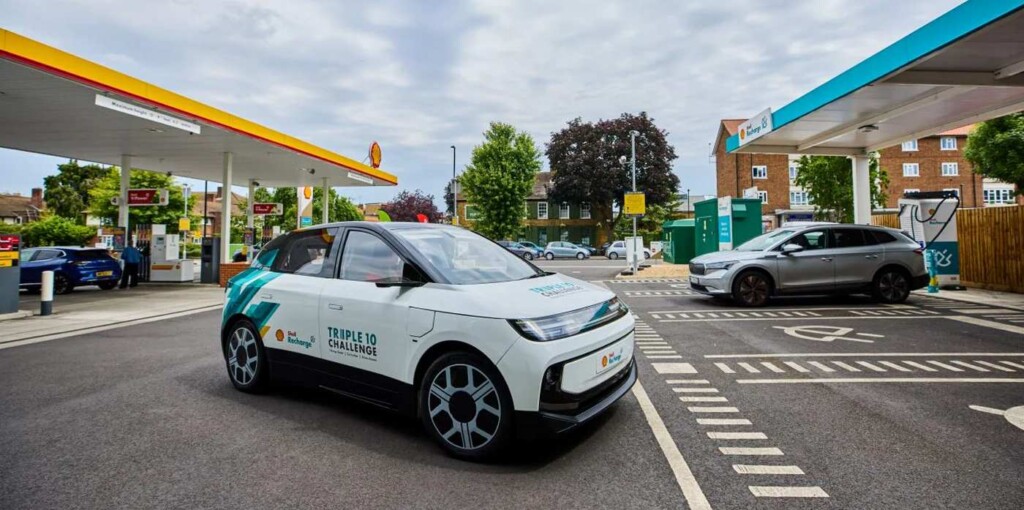 The Triple 10 Concept Car – credit, Shell, released Shell have unveiled an all-electric concept car to inspire the next generation of European-made mass-market EVs by focusing on lighter weights and better charging technology. Known as the “Triple 10 Challenge Car,” its design is centered around a simplified, single-circuit cooling architecture to efficiently manage the thermal load of charging, even with the 175 kilowatt-hour fast chargers installed on the continent today. Triple 10 refers to a car with a charge time of 10 minutes or less, that drives with a 10 kilometer (6 miles) per kilowatt-hour efficiency, and which generates 10 tons of CO2 across its whole lifecycle. Ask any motor head (or petrol head, if you’re in the UK) how many concept cars they’ve seen make it no further than a prototype, and you’d do well to find a seat as you listen to all the examples they’re likely to list. Shell make no bones about the Triple 10 car, which has no estimated list price, being a “proof-of-concept vehicle designed to inspire a new design philosophy for the next generation of battery electric vehicles,” but the accomplishments and technology they were able to pack into a compact-size vehicle are nevertheless impressive. Europe is facing an unprecedented challenge to its automotive industry as the EVs the continent’s governments have long incentivized and championed—to the point of banning internal combustion engines at future dates—are suddenly coming not from northern Italy or southern Germany, but from China. With price inflation in the Eurozone for automobiles rising between 20% and 25% between 2020 and 2025, the advent of a sub-20 grand electric vehicle has been a welcome relief for European consumers, who are choosing models like Leapmotor, BYD, and Geely at higher and higher rates than comparable models made by continental badges Volkswagen or Renault. Shell’s Triple 10 concept closely models these Chinese brands that are rapidly gaining in popularity among the bloc, namely something well-made and compact that charges quickly, in contrast to “the current reliance on ever-larger batteries.” “With the Triple 10 Challenge concept car, we have unlocked the potential for faster charging, lighter systems and improved lifecycle efficiency by using our advanced thermal fluids,” said Cara Tredget, VP for Mobility & Lubricants Technology at Shell. “Together with our co-engineering partners, we are proud to develop alternative options for sustainable EV development leveraging technologies that are available today and are scalable to support customers into the future.” Shell’s concept has been designed to achieve 10 km/kWh in driving economy with a smaller, more efficient battery system, adding over 30% improvement in overall energy efficiency compared to many current-generation EVs. For example, the extended range model of one of the best-selling Chinese EVs in Europe, the BYD Dolphin, comes with a 43 kilowatt battery pack giving it just over 300 kilometers of range, or an efficiency of around 13.3 km/kWh. The Triple 10 vehicle is also able to charge the battery from 10% to 80% in 9 minutes 54 seconds, without compromise to thermal stability or lifespan. While some EVs in the market today can charge in under 10 minutes, this requires using an ultra-fast charger in excess of 300kW, which is uncommon on the public charging network. Triple 10 Challenge vehicle is able to attain this on the existing charging network infrastructure using a standard 175kW charger, adding an equivalent to almost 90% more range added per minute of charge.The key to these performance metrics is Shell Recharge thermal fluid. Unlike traditional cooling systems that use water-glycol, Shell’s dielectric fluid allows for direct immersion cooling of the battery and indirect cooling of the powertrain components including the motor and power electronics. Shell’s New Concept EV Designed to Charge in Under 10 Minutes and Run at 6 miles per kWh |
‘Vibe coding’ is fun and easy, but there’s a major catch (2026-08-17T11:53:00+05:30)
|
Imagine you’ve always wanted your own app. Perhaps one that tracks your household budget, organises the family shopping list or reminds you when to water your plants. Until recently, turning that idea into reality would have meant learning to code or paying a software developer. Now you can simply tell an artificial intelligence (AI) chatbot about your idea. Within minutes, it can write the code, fix errors and help you build a working app. This approach is known as vibe coding. It’s fast, exciting and is making it possible for millions of people to create software for the first time. It’s easy to see why vibe coding has become so popular. Yet researchers have already found thousands of security flaws and exposed secrets in publicly available AI-generated applications. Software that appears to work isn’t always software you can trust. What is vibe coding?The term “vibe coding” was coined by AI researcher Andrej Karpathy. Rather than writing the software yourself, you describe the outcome you want – or the “vibe” – in plain, everyday language and let AI generate most or all of the software. If something doesn’t work, you ask the AI tool to fix it. You don’t necessarily need to understand how the code works – you just keep prompting until you get the result you’re after. Tools such as ChatGPT, Claude, Gemini and specialised generative AI based coding assistants have made this possible. In fact, the most recent survey by major coding platform Stack Overflow revealed that 84% of developers globally used or planned to use AI coding tools in 2025. And it’s not just developers using them: recent stats indicate about 63% of users of vibe coding platforms are people without a programming background, building products and tools of their own. People with little or no programming experience can now build websites, apps and automated workflows (such as compiling documents or doing other complex tasks) in a fraction of the time it once took. Building reliable softwareMost people imagine software developers spend their days writing code. In reality, coding is only one part of a much bigger process. Before software is released, developers ask important questions. Does it work reliably? Is it secure? Can someone else maintain it? What happens if something goes wrong? They test different situations, review each other’s work and fix problems before anyone else uses the software. These steps aren’t there to slow developers down. They’re there because even software that seems to work for its purpose can still expose sensitive data or disrupt critical systems. Vibe coding can make it tempting to skip much of this process. If the app appears to work, it’s easy to assume the job is finished. The risks of vibe codingNow, suppose you ask AI to build an app to manage your household expenses. The app opens, records your purchases and calculates your spending. Everything seems fine. But is it calculating correctly in every situation? Is your financial information stored securely? What happens if the app crashes halfway through entering your monthly expenses? Or perhaps it stores your financial data in a way that’s easy for others to access. The app does exactly what you asked – but your personal information may not be properly protected. These aren’t questions most beginners think to ask, yet they’re exactly the kinds of questions professional developers routinely consider. Fixing problems can also become frustrating. You ask the AI to solve one issue, only to discover it has introduced another somewhere else. Without understanding what the AI has changed, you’re left relying on it to solve problems it may have created. When is vibe coding enough?None of this means vibe coding should be avoided entirely. It’s an excellent way to experiment with ideas, learn programming concepts or quickly build personal tools. Entrepreneurs can create prototypes, hobbyists can automate repetitive tasks, and small organisations can explore ideas that might otherwise never get built. The risks increase when AI-generated software is treated as ready for real-world use simply because it works. Apps that handle personal information, financial transactions or business operations still need careful testing and human oversight, regardless of who – or what – wrote the code. In one security study, about 45% of AI-generated code samples failed standard security tests. The broader issue goes beyond coding. Researchers have long warned about “automation bias” – the tendency to accept recommendations from automated systems without adequately checking them. As AI becomes better at solving complex tasks, it’s becoming easier to accept its answers without questioning them. Software is just one area where this can have serious consequences, because mistakes may remain hidden until something goes wrong. AI can write code, but it can’t take responsibilityVibe coding is opening software development to people with great ideas but little programming experience. But making software easier to create doesn’t make it easier to judge whether it’s secure, reliable and ready for others to use. No matter how good AI becomes at generating code, people – not AI – must remain responsible for what that code does. Salahuddin Azad, Lecturer, School of Engineering and Technology, CQUniversity Australia and Ritesh Chugh, Professor, Information and Communications Technology, CQUniversity Australia This article is republished from The Conversation under a Creative Commons license. Read the original article. |


A solar panel recycling scheme would help reduce waste, but please repair and reuse first (2026-06-16T12:44:00+05:30)
Deepika Mathur, Charles Darwin University and Robin Gregory, Charles Darwin UniversityAustralia’s rooftop solar industry has renewed calls for a mandatory recycling scheme to deal with the growing problem of solar panel waste. Only about 10% of panels are currently recycled. The rest are stockpiled, sent overseas or dumped in landfill. One in three Australian homes now have rooftop solar panels, and new systems are being installed at the rate of 300,000 a year. Meanwhile, older systems are being scrapped – often well before the end of their useful life. This has made solar panels Australia’s fastest-growing electronic waste stream. Yet federal government plans for a national scheme to manage this waste appear to have stalled. Clearly, solar panel waste is a major problem for Australia. Recycling is one part of the solution. But Australia also needs new rules so solar panels can be repaired and reused. What are product stewardship schemes?The Smart Energy Council, which represents the solar industry, is calling for a national product stewardship scheme. Product stewardship schemes share responsibility for reducing waste at the end of a product’s useful life. They can involve people all along the supply chain, from manufacturers to importers to retailers. Such schemes may be voluntary, and industry-led, or mandatory and legislated. Alternatively, they can be shared – approved by government but run by an organisation on behalf of industry. Existing schemes manage waste such as oil, tyres, paper and packaging, mobile phones, televisions and computers. Depending on the product, a levy is paid by the manufacturer, product importer, network service provider (in case of mobile muster), retailer or consumer – or a combination of these. The money raised is then invested in recycling, research or raising awareness and administering the scheme. Establishing a solar panel product stewardship schemeSolar panel systems were added to a national priority list for a product stewardship scheme in 2017. In December 2020, the federal government called for partners to help develop the scheme, but later stated that no partnership would be struck. The government released a discussion paper for comment in 2023. The scheme has not yet been established. This is particularly problematic given Australia’s commitment to renewable energy, which will entail a rapid expansion of solar technology. Recycling should be the last resortProduct stewardship schemes assume recycling is the main solution to the waste problem. Australia’s National Waste Policy also focuses on on recycling, rather than reuse or repair. This is despite recycling being the last resort on the “waste hierarchy”, just slightly above disposal. Solar photovoltaic panels are built to last 30 years or more, and are “not made to be unmade”. They are not easy to dismantle for recycling because they are built to withstand harsh conditions. It’s difficult for Australia to influence the design of solar panels, given 99% are imported. Just one manufacturer, Tindo Solar in Adelaide, assembles solar panels on Australian soil, using imported silicon cells. Many solar panels are being removed well before their end of life, generating waste ahead of time. This is rarely because they have stopped producing power. In our previous research, we found many reasons why people chose to take solar panels down. Consumers are often advised to replace the whole system when just a few panels are faulty. Or they may simply be upgrading to a larger, more efficient system. Sometimes it’s because they want to access a new renewable energy subsidy. Renewable subsidies and other solar panel policies should be redesigned to keep panels on roofs for longer. Functioning solar panels removed before the end of their life should be reused. This would require new regulations including quality-control measures certifying second-hand solar panels, and second-hand markets. This is a much neglected field of research and development. What else should such a scheme include?Others have discussed what a solar panel product stewardship scheme could include and the possible regulatory environment. We think the scheme should also involve collecting and transporting panels around Australia, including remote areas. Unfortunately, existing product stewardship schemes do not differentiate between urban, regional and remote areas. The same is likely to be the case for a solar panel collection and recycling scheme. This leaves regional and remote areas with fewer recycling facilities and collection points. With a growing number of large solar projects in Northern Australia, reducing waste is imperative. Remote island communities in the Northern Territory bundle up their recyclables and ship it to Darwin. Removed solar panels are then transported to urban Victoria, New South Wales or South Australia for processing. Who should bear the cost of transporting this waste? Consumers, remote regional councils with small ratepayer bases, or manufacturers and retailers? A well-designed scheme would help recover valuable resources across Australia for reuse in new products. However, large volumes of solar panels would be required for recycling schemes to become commercially viable. That’s why the solar recycling industry is concerned about exporters and scrap dealers collecting panels rather then certified solar panel recyclers. Even if the technology for recycling solar panels is nascent in Australia, it’s worth stockpiling panels in Australia for later. Considering these issues in the design of a product stewardship scheme would help ensure we can maximise the benefits of renewable energy, while minimising waste. Deepika Mathur, Senior Research Fellow, Northern Institute, Charles Darwin University and Robin Gregory, Adjunct Research Fellow, Northern Institute, Charles Darwin University This article is republished from The Conversation under a Creative Commons license. Read the original article. |

NTT preparing $500m fund to boost IOWN AI initiative (2026-06-11T11:37:00+05:30)
 Posted by Harry Baldock : The vehicle will target startups across North America, Asia, and Europe to accelerate the commercial ecosystem for all-photonics networks Japan’s largest telco, NTT, is preparing to create an investment fund worth roughly $500 million to support the Innovative Optical and Wireless Network (IOWN) initiative and related AI development, according to reports from Yomiuri Shimbun. South Korea’s SK Group, Taiwan’s Chunghwa Telecom, and the Development Bank of Japan are reportedly partners in the ‘IOWN AI Fund’. More than 10 additional Japanese corporations – spanning tech giants like Toshiba, Sony, and Fujitsu, alongside major financial institutions including MUFG, SMBC, and Mizuho – have also expressed intent to participate. The ‘IOWN AI Fund’, which will be set up by the end of the month, aims to expand IOWN’s growing ecosystem and the AI infrastructure supporting it. This will be achieved by targeting tech startups across North America, Asia, and Europe, focusing on photoelectric fusion, AI semiconductors, and the development of next-generation, IOWN-native AI models. The concept of IOWN was introduced by NTT in 2019, with the central premise of shifting telco network topology from electronics to photonics (i.e., data transmission via light rather than electricity). Currently, typical backbone networks carry optical signals over fibre but are forced to convert these photonic signals into electrical signals for processing. IOWN envisions an end-to-end optical network that would remove this translational bottleneck, delivering major benefits like lower power consumption, higher speeds, and larger capacity. As generative AI data centres place unprecedented strain on global energy grids, it should be no surprise that the IOWN initiative is gaining momentum. Indeed, IOWN is already beginning to show signs of moving from technical R&D to commercial scaling. In 2024 deployment by NTT and Chunghwa Telecom successfully activated a 3,000km subsea IOWN link between Japan and Taiwan, achieving a one-way latency of just 17 milliseconds.By leveraging a formidable cross-border alliance of East Asian telecom, semiconductor, and financial giants, the IOWN AI fund is betting all-photonic network architecture will be a major alternative to traditional network strategy in the not-so-distant future. NTT preparing $500m fund to boost IOWN AI initiative - Total Telecom |
Almost 20% of Australian students don’t finish school – these 3 things can help them stay (2026-06-10T13:10:00+05:30)
Rebecca J. Collie, Monash University and Andrew J. Martin, UNSW SydneyThe latest data on Australian schooling shows about 81.5% of Year 10 students go on to Year 12. This is a modest rise of 1.6 percentage points on the previous year, but figures have been largely stable since the start of the COVID-19 pandemic. There has been decades of research on how to help students finish school. Each student is of course different and will have different needs. But there are many things schools can do from Year 7 to support students to stay until Year 12. Here are three of the most important ones. Why it’s important to finish schoolCompleting Year 12 is associated with a range of positive longer-term outcomes. These include better employment prospects, higher lifetime earnings, and stronger health and wellbeing. It also keeps the widest range of post-school options open, from vocational training and apprenticeships to further study and direct entry into work. Why do students leave?The reasons students leave before Year 12 are varied and often complex. For example, some students might be managing health challenges, navigating difficult life circumstances, or pursuing opportunities like an apprenticeship that fit their goals well. For others, however, leaving early is shaped by experiences at school itself. Somewhere along the way, they became disengaged, fell behind, or lost their connection to school. These are the experiences schools are best placed to influence. Research shows there are three key areas schools can better develop now to help increase the retention numbers in the years ahead. 1. How teachers teachIt may sound obvious but one main way schools can keep students is through teaching approaches that help students learn effectively. This is because students need to feel they can succeed at school — and see themselves making progress — in order to stay engaged and connected to it. When learning is consistently out of reach, students disengage. In contrast, when they can see themselves getting better at things, school feels worth their effort. Our research shows effective teaching in Year 7 is connected all the way through to whether a student completes school six years later. This type of teaching is also linked with students putting in greater effort at school and higher achievement. What kind of teaching practices are we talking about? One well-evidenced approach is explicit instruction where teachers clearly model new concepts and skills, guide students through examples, and gradually shift responsibility to students as they gain mastery. As part of this, two strategies stand out. First, reducing difficulty during initial learning. When a concept is new, break it into manageable steps and match the challenge to what students already know. Second, give students well-organised opportunities to practise, paired with specific guidance on how to improve. 2. How the classroom worksOrderly, predictable and positive classrooms free up students to focus on learning rather than navigating disruption. This is why classroom management is important. This is how teachers structure the classroom environment and the interactions within it so learning can happen. In a recent study, we found students whose teachers provided strong classroom management were up to six times more likely to have high motivation, engagement, and resilience at school than students whose teachers did not. Two strategies are particularly effective for classroom management. First, establishing and consistently maintaining clear rules and routines is important, so students know what to expect. Second, recognising and building on what students do well rather than only focusing on what goes wrong. 3. Student-teacher relationshipsResearch also tells us it’s important for teachers to build warm, respectful relationships with students. It is not only important for retention in its own right — it also underpins the other two areas above. Strong teaching and good classroom management both depend on positive teacher-student relationships. When students feel known and supported by their teachers, they are more willing to engage and stay connected to school. Our research shows each relationship a student has with a teacher matters. The more positive relationships students have with their teachers — relative to negative ones — the greater their academic engagement. Academic engagement in turn, is a key driver of school retention. Research tells us every teacher can make a difference, and the relationships teachers build with their students could be what helps that student stay on and complete school. This is because the relationships add up — and for some students, the bond they build with one teacher in particular can be what tips the balance toward staying engaged with school. So it is important to create conditions where every student has the chance to build genuine, positive connections with teachers. This means teachers getting to know students as individuals, showing interest in their lives beyond the classroom, and teaching in ways that feel personal and engaging. Rebecca J. Collie, Professor of Learning Sciences, Monash University and Andrew J. Martin, Scientia Professor and Professor of Educational Psychology, UNSW Sydney This article is republished from The Conversation under a Creative Commons license. Read the original article. |

An AI solution to an 80‑year‑old problem has shocked mathematicians (2026-06-03T14:01:00+05:30)
 A representation of one version of the new best arrangement of points on a plane with pairs separated by a unit distance. Álvaro Lozano-Robledo
Melissa Lee, Monash University A representation of one version of the new best arrangement of points on a plane with pairs separated by a unit distance. Álvaro Lozano-Robledo
Melissa Lee, Monash UniversityLast week, OpenAI shocked the mathematical community by revealing that one of its internal artificial intelligence (AI) models had found a counterexample to a famous conjecture made by legendary Hungarian mathematician Paul Erdős in 1946. The planar unit distance problem, or Erdős problem 90, has intrigued mathematicians for decades. The new result is no mere curiosity. Canadian mathematician Daniel Litt described it as “the first result produced autonomously by an AI that I find interesting in itself”. The breakthrough, produced with a general-purpose AI model rather than one specialised for mathematics, also highlights how AI is changing mathematical research itself. Days after OpenAI’s paper, US mathematician Will Sawin followed the same line of reasoning to an improved result. Also last week, a team from Google DeepMind used one of their own models to resolve nine lesser open problems left by Erdős. At the same time, results like this show us what kind of mathematics current AI models are good at – and where their capabilities are still uncertain. Dots and linesPaul Erdős was one of the most prolific mathematicians of the twentieth century. He was famous for asking deceptively simple questions whose solutions often resisted decades of effort. At first glance, the underlying problem seems relatively straightforward. Suppose you have some number of points – call the number n – drawn on an infinitely large piece of paper. Given you can arrange the points any way you like, how many pairs of points can be positioned exactly one unit of distance away from each other? If you try this problem yourself (on a presumably finite piece of paper), you may quickly gravitate towards a square grid as a promising candidate for the best arrangement. The spacing of the grid naturally creates many pairs at a regular distance apart.  A square grid intuitively looks like a good solution to the planar unit distance problem. OpenAI A square grid intuitively looks like a good solution to the planar unit distance problem. OpenAIThis intuition influenced much of the early thinking about the problem. As the number of points grows, grid-like arrangements continue to appear to be remarkably effective. For decades it was widely believed these highly regular structures were about as good as it gets. Erdős himself conjectured that no construction could improve substantially on these intuitive arrangements, even for an extremely large number of points. (The new best result, by Sawin, reportedly only starts to yield improvements for around 102000000 points – that’s a one followed by two million zeroes.) Over the past 80 years, mathematicians have tried to prove Erdős either right or wrong. Their efforts have linked the problem to other areas of mathematics called incidence geometry, graph theory and extremal combinatorics. While a full proof remained elusive, there was a general feeling that Erdős’ conjecture was probably true. However, OpenAI’s recent breakthrough proved Erdős’ intuition wrong. The new result uses tools from an area of mathematics called algebraic number theory to show there are patterns of dots that involve many more unit-distance pairs than the square grid, for infinitely many values of n. No hesitationIn an article OpenAI published alongside the new paper, several leading mathematicians remarked on the result. Fields Medallist Timothy Gowers wrote that if a human researcher had submitted the paper with this result to the prestigious journal Annals of Mathematics, he would have recommended publication “without any hesitation”. He also added that no previous AI-generated proof had come close to this level of sophistication. This breakthrough also represents the first major mathematical open problem solved with AI with minimal human intervention beyond the initial prompt. The accompanying paper shows the prompt given to the model, as well as a recount of the “chain of thought” conducted by the model. This has renewed broader questions about the capabilities of AI to aid in, and perform, mathematical research. Three keys to mathematical researchResearch mathematicians have been using computers for a long time, but their work is rarely driven by computation alone. Most major breakthroughs emerge from a delicate combination of three things: expertise developed over years, sustained effort to apply that expertise creatively to explore ideas (many of which turn out to be dead ends), and occasional conceptual leaps that suddenly reorganise how a problem is understood. The first two are domains where AI models excel: as noted by Gowers, large language models such as ChatGPT have an “encyclopaedic knowledge of mathematics”. Moreover, they can follow huge numbers of speculative lines of enquiry, even those unlikely to lead anywhere, without human time constraints. The latter seems to be what provided the key to success here. In hindsight, it seems an expert given a small number of hints would be likely to be able to reach the same proof. As Gowers notes:
Lightbulb momentsThe harder question is how much AI can contribute to genuine conceptual leaps. These acute moments of insight, where a lightbulb moment reframes a problem in an entirely new way, are often seen as the most human part of mathematics. These leaps are hard to formalise and even harder to predict. It remains unclear whether AI models can replicate them, even with recent advances. What is clear is that AI models are causing a seismic shift in the way mathematics is discovered. For centuries, progress in mathematics depended almost entirely on human creativity and persistence. Now, for the first time, researchers are working alongside systems capable of autonomously exploring enormous spaces of ideas and contributing to problems once thought accessible only to human insight. Melissa Lee, Senior Lecturer, School of Mathematics, Monash University This article is republished from The Conversation under a Creative Commons license. Read the original article. |
