
 A representation of one version of the new best arrangement of points on a plane with pairs separated by a unit distance. Álvaro Lozano-Robledo
Melissa Lee, Monash University A representation of one version of the new best arrangement of points on a plane with pairs separated by a unit distance. Álvaro Lozano-Robledo
Melissa Lee, Monash UniversityLast week, OpenAI shocked the mathematical community by revealing that one of its internal artificial intelligence (AI) models had found a counterexample to a famous conjecture made by legendary Hungarian mathematician Paul Erdős in 1946. The planar unit distance problem, or Erdős problem 90, has intrigued mathematicians for decades. The new result is no mere curiosity. Canadian mathematician Daniel Litt described it as “the first result produced autonomously by an AI that I find interesting in itself”. The breakthrough, produced with a general-purpose AI model rather than one specialised for mathematics, also highlights how AI is changing mathematical research itself. Days after OpenAI’s paper, US mathematician Will Sawin followed the same line of reasoning to an improved result. Also last week, a team from Google DeepMind used one of their own models to resolve nine lesser open problems left by Erdős. At the same time, results like this show us what kind of mathematics current AI models are good at – and where their capabilities are still uncertain. Dots and linesPaul Erdős was one of the most prolific mathematicians of the twentieth century. He was famous for asking deceptively simple questions whose solutions often resisted decades of effort. At first glance, the underlying problem seems relatively straightforward. Suppose you have some number of points – call the number n – drawn on an infinitely large piece of paper. Given you can arrange the points any way you like, how many pairs of points can be positioned exactly one unit of distance away from each other? If you try this problem yourself (on a presumably finite piece of paper), you may quickly gravitate towards a square grid as a promising candidate for the best arrangement. The spacing of the grid naturally creates many pairs at a regular distance apart.  A square grid intuitively looks like a good solution to the planar unit distance problem. OpenAI A square grid intuitively looks like a good solution to the planar unit distance problem. OpenAIThis intuition influenced much of the early thinking about the problem. As the number of points grows, grid-like arrangements continue to appear to be remarkably effective. For decades it was widely believed these highly regular structures were about as good as it gets. Erdős himself conjectured that no construction could improve substantially on these intuitive arrangements, even for an extremely large number of points. (The new best result, by Sawin, reportedly only starts to yield improvements for around 102000000 points – that’s a one followed by two million zeroes.) Over the past 80 years, mathematicians have tried to prove Erdős either right or wrong. Their efforts have linked the problem to other areas of mathematics called incidence geometry, graph theory and extremal combinatorics. While a full proof remained elusive, there was a general feeling that Erdős’ conjecture was probably true. However, OpenAI’s recent breakthrough proved Erdős’ intuition wrong. The new result uses tools from an area of mathematics called algebraic number theory to show there are patterns of dots that involve many more unit-distance pairs than the square grid, for infinitely many values of n. No hesitationIn an article OpenAI published alongside the new paper, several leading mathematicians remarked on the result. Fields Medallist Timothy Gowers wrote that if a human researcher had submitted the paper with this result to the prestigious journal Annals of Mathematics, he would have recommended publication “without any hesitation”. He also added that no previous AI-generated proof had come close to this level of sophistication. This breakthrough also represents the first major mathematical open problem solved with AI with minimal human intervention beyond the initial prompt. The accompanying paper shows the prompt given to the model, as well as a recount of the “chain of thought” conducted by the model. This has renewed broader questions about the capabilities of AI to aid in, and perform, mathematical research. Three keys to mathematical researchResearch mathematicians have been using computers for a long time, but their work is rarely driven by computation alone. Most major breakthroughs emerge from a delicate combination of three things: expertise developed over years, sustained effort to apply that expertise creatively to explore ideas (many of which turn out to be dead ends), and occasional conceptual leaps that suddenly reorganise how a problem is understood. The first two are domains where AI models excel: as noted by Gowers, large language models such as ChatGPT have an “encyclopaedic knowledge of mathematics”. Moreover, they can follow huge numbers of speculative lines of enquiry, even those unlikely to lead anywhere, without human time constraints. The latter seems to be what provided the key to success here. In hindsight, it seems an expert given a small number of hints would be likely to be able to reach the same proof. As Gowers notes:
Lightbulb momentsThe harder question is how much AI can contribute to genuine conceptual leaps. These acute moments of insight, where a lightbulb moment reframes a problem in an entirely new way, are often seen as the most human part of mathematics. These leaps are hard to formalise and even harder to predict. It remains unclear whether AI models can replicate them, even with recent advances. What is clear is that AI models are causing a seismic shift in the way mathematics is discovered. For centuries, progress in mathematics depended almost entirely on human creativity and persistence. Now, for the first time, researchers are working alongside systems capable of autonomously exploring enormous spaces of ideas and contributing to problems once thought accessible only to human insight. Melissa Lee, Senior Lecturer, School of Mathematics, Monash University This article is republished from The Conversation under a Creative Commons license. Read the original article. |

Hyundai, Kia unveil new EVs, concept models (2025-11-14T13:03:00+05:30)
 IANS Photo IANS PhotoSeoul, (IANS) Hyundai Motor and its affiliate Kia said on Friday they have unveiled their latest electric vehicle (EV) units and concept models under way at the 2023 Los Angeles Auto Show as the companies strengthen their electric portfolios. Hyundai debuted the Ioniq 5 N, the first high-performance EV model of the company's N brand aimed at the North American market. The Ioniq 5 N is equipped with a high-performance all-wheel-drive system and a high-output 84 kilowatt-hour battery, providing a combined output of 448 kilowatts, reports Yonhap news agency. Hyundai also showcased its all-new 2024 Santa Fe SUV model. The company emphasized the unit's robust and sturdy exterior design, along with its large tailgate and interior space. Kia said it held a prelaunch press event Thursday (local time) and unveiled two concept models -- the EV3 and EV4. The EV3 is characterized by the implementation of Kia's new digital Tiger Face design for the company's EVs. It conveys a sturdy and technologically advanced impression through a compact and robust design language. Kia said the EV4 embodies the company's innovative attempt toward the future under its design philosophy, named "Opposite United," which encapsulates the direction Kia is pursuing for the next-generation electric sedan., Kia Hyundai, Kia unveil new EVs, concept models | MorungExpress | morungexpress.com |
Designing for impact: How product innovation is enabling scalable, intelligent infrastructure (2025-09-15T11:53:00+05:30)
 Posted by Harry Baldock, Contributed Article: By Pete England, Product Director, ITS  For decades, the business connectivity market has been defined by compromise. Organisations were forced to choose between two technologies: copper, cheap but unreliable, or leased lines, reliable but unaffordable for most businesses. Neither option truly reflected what businesses needed. Copper couldn’t deliver consistency. Leased lines often meant overpaying for bandwidth that was only essential during peak usage. Connectivity was a limiting factor, not an enabler. Today, that dynamic is changing. As the UK fibre rollout shifts into a “fibre utility” phase, the opportunity lies not just in building networks, but in designing products that match the way businesses and public services now operate. A market transformed by digital society Every aspect of modern work is underpinned by reliable connectivity. From cloud-based CCTV and IP-enabled cameras, to collaboration platforms like Teams and SharePoint, to guest Wi-Fi and cashless point-of-sale terminals – connectivity is no longer a utility, but the foundation of digital society. This creates new demands:Scalability, to grow as application use increases. Reliability, because downtime is no longer an option. Security, as every connection point becomes a potential risk. Traditional products can’t keep pace. Many businesses find themselves paying for capacity they only need at peak times, or trying to stretch inadequate services across mission-critical applications. As digital convergence accelerates, those compromises are no longer acceptable. That’s why product innovation has to move faster than traditional providers can adapt. At ITS, we’ve made it our mission to design services that evolve with applications, not against them. Smarter by design Connectivity should not be a hard-coded, one-size-fits-all commodity. It should be agile, consumable, and customisable. Our modular product framework gives partners and customers the ability to:Shape solutions for specific needs, sectors, and use cases. Flex bandwidth, service levels, and commercial models. Integrate seamlessly with partner platforms for quoting, ordering, and lifecycle management. This approach removes the perennial issue of overselling. Instead of locking customers into a leased line at 1Gbps when they only need 100Mbps, our products can be tuned and scaled remotely. No truck roll, no wasted spend – just a right-sized service that can grow as demand grows. We’ve also invested heavily in rapid provisioning through our partner portal. By cutting fibre lead times and enabling full integration with partner systems, we’re giving resellers the tools to compete harder in a market where speed of delivery is a true differentiator. This isn’t just infrastructure. It’s infrastructure designed for outcomes. Closing the gaps: A three-tiered portfolio Our product ladder has been deliberately shaped to address every segment of the business market, without forcing compromise.FibreOne – A reliable entry-level FTTP business broadband service. Perfect for organisations with basic connectivity needs, such as payment terminals or internet radio. It runs at consistent speeds and provides a clear upgrade path when requirements grow. FibreLight – The missing middle ground. Businesses that outgrow FTTP shouldn’t be forced into costly leased lines. FibreLight fills this gap, offering scalability, reliability, and performance at a price point that makes sense. It’s a commercial innovation that allows customers to unlock cloud-based applications without overspending. In many ways it’s the “EFM killer” – removing the awkward choice between too little and too much by creating a product that truly sits between. FibreBright – For those who demand absolute certainty. FibreBright is our premium leased line service, delivering dedicated, uncontended performance around the clock. It supports customers that require mission-critical resilience, with clear paths to higher speeds and optical services. What makes this portfolio powerful is not just the breadth of choice, but the designed-in upgrade paths. Businesses can start small, grow, and adapt without having to rip and replace, often as the competition needs to. Partners, meanwhile, can approach their customers with a suite of options that are both commercially compelling and technically future-proof. Looking ahead: From connectivity to smart infrastructure The next phase of our innovation journey is about making connectivity smarter, not just faster. That means embedding intelligence, security, and automation into the core of our services. It means designing for compliance and ESG goals, not as bolt-ons but as part of the network’s DNA. It also means recognising that, in a market where competitors still build siloed services, ITS has done something different. We’ve created a singular, software-configurable network that delivers economies of scale and allows for modularity at the service-spec level. In practice, this means:Care packages and service levels can be added like software modules. Speeds can be flexed remotely, without a site visit. Capacity can be reused rather than wasted. This is the connective tissue that enables partners and end customers to consume connectivity more like a cloud service: buy what you want, when you want it, and flex it as your needs change. Redefining the market Connectivity isn’t “done.” The market doesn’t need more commodity bandwidth layered with bolt-on services. It needs connectivity that is inherently better: faster, smarter, more flexible, and ultimately more affordable. By understanding the traditional pain points and addressing them with flexible, modular design, ITS is creating a portfolio that sets a new benchmark. It’s not about competing with incumbents on their terms. It’s about redefining the terms altogether – closing market gaps, making connectivity more equitable, and creating infrastructure that’s ready for the next decade of digital society. Want to learn more about the future of smart infrastructure? Stop by for a drink at the Dog & Duct pub at Connected Britain, sponsored by ITS g for impact: How product innovation is enabling scalable, intelligent infrastructure | Total Telecom. Designing for impact: How product innovation is enabling scalable, intelligent infrastructure |
ABS approves second Korean floating SMR plant design (2025-07-23T12:45:00+05:30)
_65954.jpg) Kwang-Sik Won, Senior Executive Vice President of HD HHI Offshore Business Division (left), with Patrick Ryan of ABS (Image: ABS) Kwang-Sik Won, Senior Executive Vice President of HD HHI Offshore Business Division (left), with Patrick Ryan of ABS (Image: ABS)Maritime classification society the American Bureau of Shipping has issued approval in principle to HD Hyundai Heavy Industries and HD Korea Shipbuilding & Offshore Engineering for a concept of a floating small modular reactor-powered power module. The design developed by HD Hyundai Heavy Industries (HHI) and HD Korea Shipbuilding & Offshore Engineering is intended to generate electricity offshore and near shore, supporting port facilities and onshore communities. The American Bureau of Shipping (ABS) completed design reviews based on the ABS Requirements for Nuclear Power Systems for Marine and Offshore Applications. Launched in October 2024, ABS says these are the industry's first comprehensive rules for floating nuclear power plants. At the time of the launch, ABS noted it is the responsibility of nuclear regulators to license the reactor and applicable nuclear safety structures, systems and components. As part of the Novel Concept Class Approval process, ABS grants an Approval in Principle at an early conceptual design phase to assist the client in demonstrating project feasibility to its project partners and regulatory bodies. Approval in Principle confirms that the proposed novel concept that includes the new technology complies with the intent of the most applicable ABS Rules and Guides as well as required appropriate industry codes and standards, subject to a list of conditions. "Floating nuclear power facilities show promise in supporting power grids, microgrids, industrial and port operations, data centres, and other uses," said Patrick Ryan, ABS Senior Vice President and Chief Technology Officer. "Additionally, today's advanced nuclear technology has a different risk profile from traditional reactor technology with state-of-the-art designs and with lower enrichment fuels, making commercial offshore and maritime applications more viable." An HD Korea Shipbuilding & Offshore Engineering spokesperson said: "The floating nuclear power plant is expected to play a key role in building a future powered by clean energy. We will remain fully committed to developing the necessary technologies and ensuring its successful realisation." This is the second Approval in Principle for a floating nuclear power barge design granted to HD Korea Shipbuilding & Offshore Engineering by the ABS. In October 2023, it issued Approval in Principle for a floating offshore nuclear power barge intended to serve as offshore power generation for remote communities and island electrification. HD Korea Shipbuilding & Offshore Engineering previously obtained approval in principle from the ABS for a 15,000 TEU-class container ship design model applying small modular reactor (SMR) technology.In February this year, HD Korea Shipbuilding & Offshore Engineering unveiled another nuclear-powered container ship model utilising SMR technology. It said the new design model features enhanced economic efficiency and safety by incorporating actual equipment and safety design concepts. ABS approves second Korean floating SMR plant design |
The Sole Prototype of the First Chinese Typewriter Was Discovered in a New York Basement (2025-07-02T11:22:00+05:30)
 A close up of the Ming Kwai typewriter – credit Elisabeth Van Boch, supplied to GNN A Stanford scholar has been rewarded for his work documenting Chinese computing by winning his university the chance to purchase the only known prototype of the first-ever Chinese typewriter after it was found in a basement. Receiving offers through Facebook and Reddit from museums and institutions around the world, New Yorker Jennifer Felix and her husband quickly became overwhelmed and astonished by the response to their basement discovery. “Is it even worth anything? It weighs a ton!” Felix’s husband wrote along with pictures of the “Ming Kwai” typewriter. As it happened, one of the commenters pointed the couple to a book by Stanford history professor Thomas Mullaney called The Chinese Typewriter: A History. Inside, a whole chapter was dedicated to the 明快打字機 which Stanford University Press write is typically just called by the first two characters which mean “bright” and “fast”—Ming Kwai. The Ming Kwai was the first Chinese typewriter ever to include a keyboard. It was invented by Chinese-born author, translator, and cultural commentator Lin Yutang in the 1940s. The whole notion that a language with around 80,000 written characters could somehow be adapted for use in a typewriter seems bonkers. Today, writing digital text with a keyboard or phone in Chinese works by typing Western letters corresponding to the sound of the character, for example “ming” and then selecting which ming, since there are several, is needed for the text. A digital database wasn’t available in the 1940s, so incredibly, Lin created a mechanical hard drive. “The depression of keys did not result in the inscription of corresponding symbols, according to the classic what-you-type-is-what-you-get convention, but instead served as steps in the process of finding one’s desired Chinese characters from within the machine’s mechanical hard drive, and then inscribing them on the page,” Mullaney wrote in his book. The Ming Kwai’s keys contain a mixture of characters and components found in many different Chinese words. For example, in the center of the bottom row, the left-most keys between the two red ones are “er” and “xin,” both of which are characters themselves, but also can be component to larger, more complex characters. Xin, for example, means “heart” but when placed below “ni” forms the character “nin” which is a formal way to address someone. The post-war Chinese typist would depress a key in the top row, triggering a rotation in the central mechanical database that would bring a certain number of common characters into view in a part of the typewriter called the “eye”. depressing a key in the middle row would trigger a second rotation corresponding to the first, and bring up another set of characters containing both component parts, and so one to the bottom row. 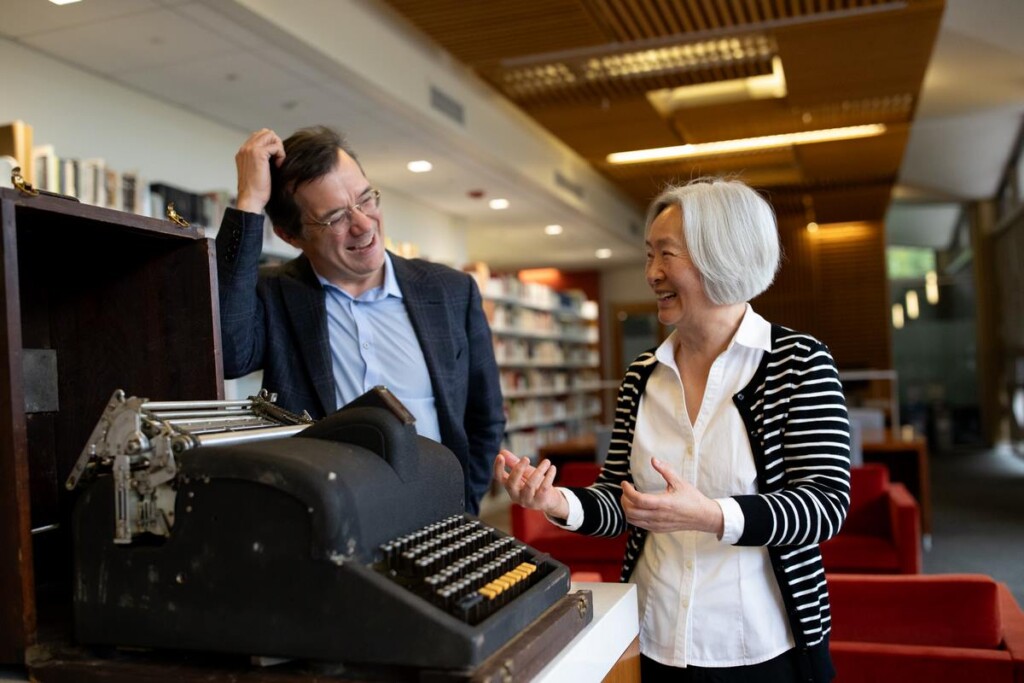 History professor Thomas Mullaney and Zhaohui Xue, curator of Chinese studies examine the Ming Kwai typewriter – credit Elisabeth Van Boch, supplied to GNN History professor Thomas Mullaney and Zhaohui Xue, curator of Chinese studies examine the Ming Kwai typewriter – credit Elisabeth Van Boch, supplied to GNNWithin the “eye” lay a final selection of characters containing the components selected for on each row, and by pressing one of the numbered keys, the character would be printed onto the page. Ingenious, to say the absolute minimum. “In 1947, the Carl E. Krum Company built what is believed to be the sole prototype of Lin’s invention,” Stanford press wrote. “A year later, in debt and unable to generate interest in mass producing his machine, Lin sold the prototype and the commercial rights to the Mergenthaler Linotype Company, where Felix’s grandfather worked as a machinist.” With the help of a foundation established by two Americans of East Asian heritage, Stanford University was able to acquire the Ming Kwai and pay for its maintenance, but Mrs. Felix felt that Stanford were the most suitable custodians of the machine, since it was Mullaney’s book that helped clue her in on what it was she and her husband found in their basement.“I didn’t want this unique, one-of-a-kind piece of history to disappear again,” she said. The Sole Prototype of the First Chinese Typewriter Was Discovered in a New York Basement |
E-bikes for everyone: 3 NZ trials show people will make the switch – with the right support (2025-06-26T10:55:00+05:30)
|
Caroline Shaw, University of Otago; Karen Witten, Te Kunenga ki Pūrehuroa – Massey University, and Simon Kingham, University of Canterbury Anyone who uses city roads will know e-bikes have become increasingly popular in Aotearoa New Zealand. But we also know rising e-bike sales have been predominantly driven by financially well-off households. The question now is, can e-biking be accepted and embraced by people and communities where it is currently not happening? Three pilot programmes from around the country have now given us cause for optimism. Understanding more about the barriers to e-bike access – especially in communities with low cycling levels or where income levels mean bikes are prohibitively expensive – has been one of the main gaps in our knowledge. But over the past few years, we have been involved in projects designed to examine how e-bikes might work in such places. The three pilots were based in Mangere (South Auckland), Wainuiomata (Lower Hutt) and Sydenham (Christchurch). These are all areas or communities with lower relative incomes and lower levels of cycling. The majority of individuals involved did not routinely cycle, and some hadn’t been on a bike for decades. In all three pilots, the results were positive. In some cases, participants reported long-term, life-changing benefits. What the pilot schemes showedEach pilot was different. The Mangere programme loaned e-bikes to people for two to three months between 2022 and 2023 through a community bikehub. The Wainuiomata programme involved a longer loan period of one year over 2023, and was run through a health provider at a local marae. The Christchurch programme, which ran between 2021 and 2024, was a free e-bike share scheme for tenants in a specific social housing complex, organised through a partnership with a shared e-bike provider. Where needed, participants in all pilots were supported as they gained riding confidence and knowledge of safe cycling routes. Participants in all the pilot programmes found e-biking acceptable, and they used and enjoyed the bikes. While these pilots were not set up to measure distance travelled, we know from other research that participants in e-bike access schemes ride on average 5km per day, half of which replaces car trips. Individuals reported practical benefits such as being able to travel to their jobs, mental and physical health improvements, and not having to pay for petrol each week. In the Wainuiomata pilot there were wider ripple effects, with participants reporting whānau members also started cycling as a result of the loan scheme. In one case, ten members of the wider whānau got involved. 3 policy actions needed nowThese results mirror what we know already about how e-bikes can improve physical and mental health, reduce transport greenhouse gas emissions, and make cities nicer places by reducing car use. Compared to conventional bikes, e-bikes also allow people to bike further and in hillier places. They are also great for groups with traditionally lower levels of cycling, such as people with health conditions, disabilities, older people and women. It also seems concerns about increased rates of injury may be less significant than initially thought. Overall, the broad benefits of e-bikes have seen hundreds of access schemes developed globally, including many in New Zealand. Combining international evidence and experience with the information from the three local pilot programmes, we see three main policy areas that will increase e-bike uptake and use in New Zealand. 1. Physical infrastructure: this is needed to support cycling in all our cities and larger towns, and would involve a combination of cycle lanes and low-traffic neighbourhoods, alongside expanded bike parking and storage. The Climate Change Commission has recommended these networks be constructed, and experience from Wellington shows rapid construction is possible. 2. Targeted access schemes: these help people who can’t afford e-bikes. Without targeting, such schemes tend to be mainly used by the well-off. It’s likely we will need a range of options, such as short-term and long-term low-cost (or free) loans, rent-to-buy schemes or subsidies. People should be able to access these schemes through a variety of organisations so as to target different motivations: saving money, improving health, commuting for work, ferrying children, environmental concern. 3. Local organisation networks: these support individuals and communities to access bikes, maintain them, provide rider training, run bike libraries, route finding and community events to support and encourage people to ride. This wider support was a key factor to the success of the all pilots. Local organisations, champions and leaders are essential to help overcome some of the practical and cultural barriers that exist because we have such low levels of cycling. Change is achievableWhat we have outlined constitutes a different way of doing business for the transport sector. But there are already organisations doing a lot of this work, including bike hubs and cycling community organisations. Others have infrastructure in place that could expand to encompass e-bike programmes, such as marae and community health centres. What is needed is a commitment to support these activities as part of core transport business policy. We don’t need to wait for more research. The three things required – building infrastructure, increasing access and providing support programmes – are all understood and achievable. E-bikes can and should play an important role in expanding New Zealand’s transport options and improving the wellbeing of its people. Caroline Shaw, Associate Professor in Public Health, University of Otago; Karen Witten, Professor of Public Health, Te Kunenga ki Pūrehuroa – Massey University, and Simon Kingham, Professor of Human Geography, University of Canterbury This article is republished from The Conversation under a Creative Commons license. Read the original article. |

CEAT rolls out new premium retail concepts in Sri Lanka to match brand’s growth | Daily FT (2025-06-14T11:38:00+05:30)
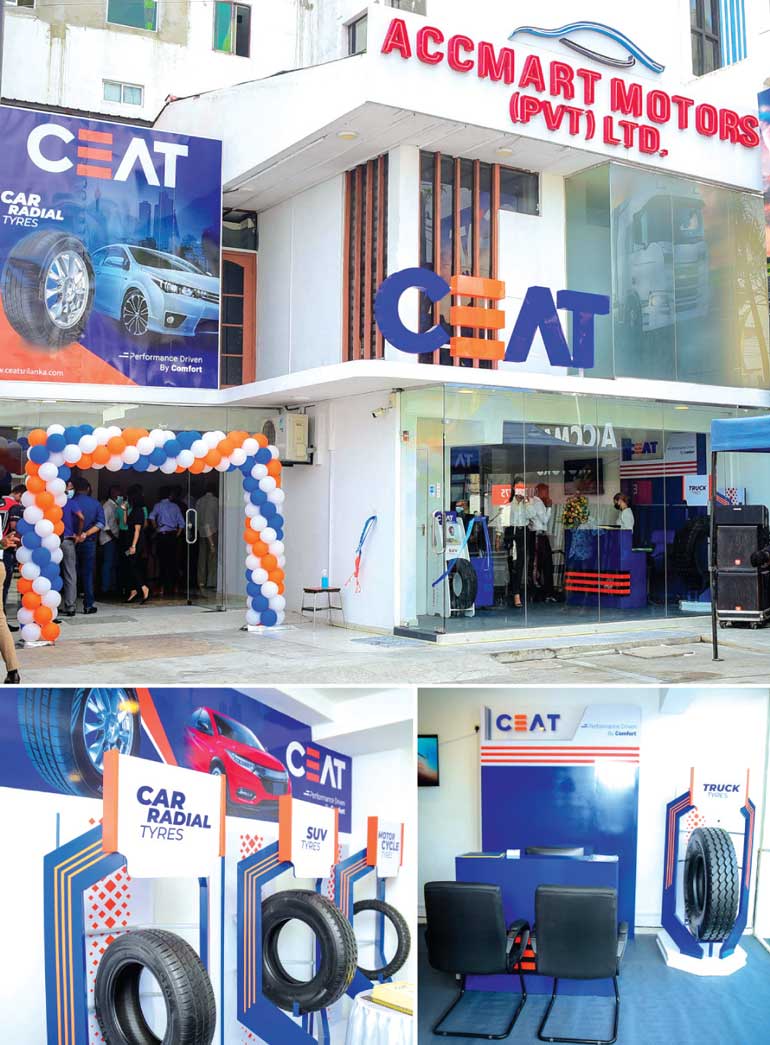 Launches distribution channel expansion with ‘SIS’ and ‘CIDO’ outlets to drive premiumisation and enhance customer, dealer experience CEAT Kelani Holdings has begun the rollout of two new retail concepts in Sri Lanka for the CEAT brand. Part of a three-year distribution channel expansion strategy designed to drive brand exclusivity and premiumisation and enhance customer experience at partner outlets in tandem with product improvements, these new retail concepts are branded ‘Shop in Shop’ (SIS) and ‘Company Invested Dealer Operated’ (CIDO) business models, the company said. They were developed in consultation with CEAT India, and shadow the CEAT ‘Shoppe’ retail concept already launched in the subcontinent. The CEAT Shop in Shop concept entails demarcating a dedicated area for CEAT branded tyres within existing multi-brand dealer premises. CEAT will furnish the floor, customer lobby and reception areas of this private space to augment customer comfort. Additionally, the company will also invest in interior branding, signage, and innovative product display racks to emphasise the tyre offerings available with the channel partner. Besides enhancing the visibility and positioning of the brand, this model will also increase the channel partners’ share of wallet, the company said. CEAT has already launched two SIS retail outfits in Colombo and plans to complete four more before the close of 2023. The Company Invested Dealer Operated or CIDO outlets are essentially CEAT flagship stores established around the island to create an exclusive space for the brand. CEAT CIDOs are designed to significantly enhance brand visibility, customer engagement, and crucially, the customer experience. As the name suggests, CEAT will invest in these outlets by providing tyre changing equipment in addition to the branding suite, the furniture, and fixtures for these outlets. Managing Director Ravi Dadlani said: “CEAT’s emergence as the top brand in Sri Lanka’s tyre sector is the result of substantial investments over several years that have seen not just exponential increases in volumes but expansion of the product range, the deployment of new technology and quantum improvements in quality. “It is therefore important that the visibility of the brand at the retail end as well as the customer experience, keep pace with, and do justice to, the brand’s growth. The SIS and CIDO concepts are part of that process.” The manufacturer of half of the Sri Lanka’s pneumatic tyre requirements, CEAT Kelani Holdings is considered one of the most successful India – Sri Lanka joint ventures. The joint venture’s cumulative investment in Sri Lanka to date exceeds Rs. 8 billion, and another Rs. 3.2 billion has been committed in 2022 for expansion of volumes, technology upgrades and new product development. The company’s manufacturing operations in Sri Lanka encompass tyres in the radial (passenger cars, vans, and SUVs), commercial (nylon and radial), motorcycle, three-wheeler, and agricultural vehicle segments. The CEAT brand accounts for market shares in Sri Lanka of 48% in the Radial segment, 80% in the Truck category, 84% Light Truck tyre category, 51% in the Three-Wheeler tyre segment, 36% in the Motorcycle tyre segment and 72% in the Agricultural vehicle tyre category. CEAT Kelani exports about 20% of its production to 16 countries in South Asia, the Middle East, Africa, and the Far East. CEAT rolls out new premium retail concepts in Sri Lanka to match brand’s growth | Daily FT |
Nagaland: Workshop explores multi- sectoral model of vocational education (2025-06-14T11:37:00+05:30)
 Kohima, May 10 (MExN): As part of the NEP Multi Skill Education Pilot, a three-day Training of Trainers (ToT) workshop on the Multi-Sector Approach to Vocational Education for Grades 9 and 10 was conducted at the SCERT SIEMAT Hall in Kohima, Nagaland from May 6 to 8. Organised by Lend A Hand India, as the technical and knowledge partner of Samagra Shiksha, the workshop aimed to build teacher capacity for delivering skill-based education aligned with the National Education Policy (NEP) 2020 and the National Curriculum Framework (NCF) 2023. The pilot is sponsored by LIC Housing Finance (LIC HFL), as part of their Corporate Social Responsibility (CSR) initiatives, stated a press release received here. The training brought together vocational teachers and officials from across Nagaland to explore a multi-sectoral model of vocational education, focusing on three core domains: Finance, Mechatronics, and Agriculture. The objective was to provide students in Grades 9 and 10 with diverse, practical skill sets relevant to both local and national employment markets, while also promoting entrepreneurship and closing critical skill gaps. The workshop was inaugurated by Dr Chumbeni Kikon, Joint Mission Director of Samagra Shiksha, in the presence of key officials including Temjenmenla, Deputy Director of SCERT; Nukshila Angh, State Coordinator for Vocational Education; Dziesevolie Tsurho, Academic Officer, NBSE and Dr Zalio Seyie, Assistant Academic Officer, NBSE. The opening session included an overview of vocational education developments in Nagaland and appreciation for the efforts of vocational teachers.  Altogether, 21 participants, comprising a mix of vocational teachers and general subject teachers from the districts of Kiphire, Peren, Mokokchung, Dimapur and Kohima attended the workshop. The workshop was also attended by officials from the three sister departments- Department of School Education, SCERT and NBSE over the course of 3 days. The training sessions were facilitated by a team of six members from Lend A Hand India. Each day of the training focused on one vocational sector, combining theoretical instruction with hands-on learning experiences: Day 1 covered personal finance, budgeting, banking operations, and entrepreneurship. Participants engaged in simulation activities and practical demonstrations designed to translate financial concepts into classroom teaching. The topic of ‘Mechatronics’ was covered on day two. It focused on basic electronics, mechanical systems, and automation. Teachers participated in assembling circuits, testing components, and understanding interdisciplinary applications. Day 3 covered on agriculture. It emphasised sustainable farming practices, crop planning, and agribusiness. Practical sessions included seed treatment, soil testing, and school-based agriculture project planning. The workshop emphasised experiential learning, encouraging teachers to adopt student-centered, activity-based approaches. Trainers from Lend A Hand India facilitated interactive sessions with tools and techniques adaptable to classroom environments. A key aspect of the training was the multi-sector approach, enabling students to experience a variety of vocational domains rather than being limited to a single track. This aligns with NEP 2020’s vision of holistic skill development and broad exposure to career pathways at an early stage.The workshop is part of a broader effort under the NEP 2020 to ensure that at least 50% of learners at the secondary level receive vocational education by 2025. Nagaland: Workshop explores multi- sectoral model of vocational education | MorungExpress | morungexpress.com |
Ten classics of Indigenous design (2025-05-08T13:13:00+05:30)
|
Blak Design Matters is the first exhibition in Australia specifically dedicated to contemporary Indigenous design. Its curator, architect and academic Jefa Greenaway, describes the show as a snapshot that “takes the pulse of what’s happening now”. Indigenous art is well known but the Blak Design Matters exhibition prompts one to think about other iconic Indigenous expressions of “design” throughout our history. Separating art from design is not always clear cut, especially when you consider people like William Barak and Tommy McRae - arguably communication designers of their time. Both used art to bridge culture and facilitate understanding during a highly tumultuous period for Indigenous people. I believe we need to find better ways to acknowledge the Indigenous design excellence that has long existed in the home of the world’s oldest, continuous living cultures. We should celebrate the engineering genius of the Boomerang and sophistication of the Budj Bim aquaculture systems in south-western Victoria, which predate the Egyptian pyramids. In 2015, David Unaipon (Ngarrindjeri), a prolific and talented industrial designer, was inducted posthumously into the Design Institute of Australia Hall of Fame. Ironically, he had died in 1967, the year Indigenous people were finally recognised in the constitution. Unaipon, who features on our $50 note, registered over 19 provisional patents inventions during his life including the mechanical shearing clippers. In 1929, he wrote: “As a full-blooded member of my race I think I may claim to be the first, but I hope not the last, to produce an enduring record of our customs, beliefs and imaginings”. Culturally oriented, Indigenous-owned businesses including design companies are now on the rise. We still have a long way to go but here is my (subjective) list of iconic Indigenous designs. These designs are informed by the times in which they were created - yet they resonate across cultures as an enduring record of “Indigenous customs, beliefs and imaginings”. Aboriginal Flag, 1971Designed by Harold Thomas, a Luritja man of Central Australia, the flag was first flown on National Aboriginal Day in Adelaide in 1971. It has had an impact like no other contemporary Indigenous design. Thomas created the flag as rallying symbol of race and identity. The black represents the Aboriginal people, the red the earth - a connection to land - and the yellow, the sun, giver of life. The flag has become a symbol for change, displayed at protest marches, on banners and posters. In 1998, I met Thomas and asked him if he thought the Aboriginal Flag would eventually become Australia’s. His answer was no! He wanted it to remain an activist flag, as originally intended. Cycle of Life opera cape, 1987This full-length opera cape with a hood of hand-painted, cotton drill was designed by Bronwyn Bancroft, a Bunjulung woman, and is now part of Sydney’s Museum of Applied Arts & Sciences collection. A wearable work of art, it represents the journey through life of an Indigenous man and woman. Designed specifically for a parade at the Paris department store Au Printemps in 1987, the interest this cape generated helped blaze a trail for the current crop of Indigenous fashion designers. ATSIC logo, 1990The logo for the Aboriginal Torres Strait Islander Commission was designed by Clive Atkinson, a Yorta Yorta and Dja Dja Wurrung man from Echuca, who describes himself as the first Australian Aboriginal man to own and operate a graphic design/advertising company. The logo was commissioned by the then Prime Minister, Bob Hawke, with the brief for it coming from Lois/Lowitja O'Donoghue, inaugural ATSIC chairperson. O'Donoghue wanted a statement of coming together. Atkinson based the logo design on a traditional meeting place symbol, which is familiar to many communities across Australia. Marcus Lee Design logo (symbol element), 1996Designed by Marcus Lee, a Karajarri man, originally from Darwin, the hand in this logo references Northern Territory Aboriginal rock art. The eye makes a connection between heart and hand as the so-called window to the soul. As Leonardo da Vinci said, “Where the spirit does not work with the hand there is no art”. Marcus Lee is a highly respected Indigenous designer who has created many powerful, culturally-themed designs including the NAIDOC week and Supply Nation logos. Girrawaa Creative Work Centre, Bathurst Jail, 1998The brief for this centre was to create an arts and culture facility inspired by the goanna, a totem for many people in the Bathurst area. This was a new approach for correctional facilities at the time. It was designed by architects Dillon Kombumerri, a Yugembir man, and Kevin O'Brien, a Kaurereg and Meriam man, and interior designer Alison Page, a Walbanga and Wadi Wadi woman. The naming and conceptual direction for the building was determined by the prison’s Indigenous inmates, and this cultural consultation was key to the project’s success. “Girrawaa” means “goanna” in the Wiradjuri language. Qantas, Wunala Dreaming, 1993Balarinji Designs’ Wunala Dreaming was a confident, Indigenous-led statement that proudly celebrated Australia’s rich, pre-colonial culture. “We wanted to challenge existing approaches to Australian visual identity, which looked largely to Europe and America for inspiration, and which failed, in our view, to harness the unique heartbeat of Australia,” its designers, Ros and John Moriarty (Yanyuwa), said in 2014. A Boeing 747 was overlaid with Aboriginal-inspired designs evoking the colours of the bush, the wetlands and the reds of Uluru. Originally planned as a three-month promotion, Wunala Dreaming became the world’s most photographed aircraft and would fly for 17 years. Murri Totems environmental sculptures, 2012Located at La Trobe University’s Institute of Molecular Science, these poles were designed by Reko Rennie, a Kamilaroi man. Rennie is unique in the way he combines expressions of Indigenous culture with contemporary design sensibilities. G20 Summit Brisbane logo, 2014This logo was created by Gilimbaa Creative Agency, co-founded by David Williams, a Wakka Wakka man, and Amanda Lear. Australia’s largest Indigenous-owned, communication design company, it attracts high profile clients from both the private and public sectors. Partly inspired by Torres Strait Islander weaving techniques, the G20 logo also features a rainbow serpent. It is a great example of how diverse Aboriginal and Torres Strait Islander cultures can project a unified identity internationally. Marlu Chair, 2015The Marlu chair and other designs by Nicole Monks, a Wajarri and Yamatji woman from Sydney, are setting a new direction for Australian design, which intelligently combines modernist and traditional inspirations and aesthetics. “Marlu”, meaning kangaroo, was inspired by a trip back on Country to visit her 93-year-old “Auntie” Dora and reminiscing about Nicole’s great-grandmother’s renowned kangaroo tail stew. I love the heartfelt motivation and inspiration behind this piece. Ngarara Place, RMIT University, Melbourne, 2016Designed by Jefa Greenaway, a Wailwan and Kamilaroi man from Melbourne, the award-winning Ngarara Place is widely acknowledged as a groundbreaking design. It is unique in that this space, located in the heart of Melbourne, was created, designed and built by a predominantly Indigenous team. Themed on the seven seasons of the Kulin Nations, this courtyard is a perfect setting for ceremonial gatherings in the centre of one of Australia’s largest cities. Also worth a mention are two highly-talented Melbourne designers whose work appears in Blak Design Matters: 23-year-old Lyn-Al Young, a Gunnai, Wiradjuri, Gunditjmarra and Yorta Yorta woman and Maree Clarke a Mutti, Wamba Wamba, Yorta Yorta and Boon Wurrung woman. Clarke’s jewellery design (Thung-ung Coorang) combines customary organic materials with 3D printed forms modelled from kangaroo teeth (gold plated), echidna quills and crow feathers. I also like the way the LYN-AL fashion brand crosses cultures while maintaining its historical integrity. Her “wearable art” - a contemporary interpretation of traditional culture - resonates with Indigenous youth and in doing so, keeps customs, beliefs and imaginings alive. Blak Design Matters runs from Saturday July 21 to Sunday September 30, 2018 at the Koorie Heritage Trust, Federation Square, at Melbourne. Dr Russell Kennedy, Senior Lecturer in Screen and Design, Deakin University This article is republished from The Conversation under a Creative Commons license. Read the original article. |

AI doesn’t really ‘learn’ – and knowing why will help you use it more responsibly (2025-03-11T13:06:00+05:30)
|
What if we told you that artificial intelligence (AI) systems such as ChatGPT don’t actually learn? Many people we talk to are genuinely surprised to hear this. Even AI systems themselves will often tell you confidently that they are learning systems. Many reports and even academic papers say the same. But this is due to a misconception – or rather a loose understanding of what we mean by “learning” in AI. Yet, understanding more precisely how and when AI systems learn (and when they don’t) will make you a more productive and more responsible user of AI. AI does not learn – at least not like humans doMany misconceptions around AI stem from using words that have a certain meaning when applied to humans, such as learning. We know how humans learn, because we do it all the time. We have experiences; we do something that fails; we encounter something new; we read something surprising; and thus we remember, we update or change the way we do things. This is not how AI systems learn. There are two main differences. Firstly, AI systems do not learn from any specific experiences, which would allow them to understand things the way we humans do. Rather they “learn” by encoding patterns from vast amounts data – using mathematics alone. This happens during the training process, when they are built. Take large language models, such as GPT-4, the technology that powers ChatGPT. In a nutshell, it learns by encoding mathematical relationships between words (actually, tokens), with the aim to make predictions about what text goes with what other text. These relationships are extracted from vast amounts of data and encoded during a computationally intensive training phase. This form of “learning” is obviously very different to how humans learn. It has certain downsides in that AI often struggles with simple commonsense knowledge about the world that humans naturally learn by just living in the world. But AI training is also incredibly powerful, because large language models have “seen” text at a scale far beyond what any human can comprehend. That’s why these systems are so useful with language-based tasks, such as writing, summarising, coding, or conversing. The fact these systems don’t learn like us, but at a vast scale, makes them all-rounders in the kinds of things they do excel at. Once trained, the learning stops
Most AI systems that most people use, such as ChatGPT, also do not learn once they are built. You could say AI systems don’t learn at all – training is just how they’re built, it’s not how they work. The “P” in GPT literally stands for “pre-trained”. In technical terms, AI systems such as ChatGPT only engage in “training-time learning”, as part of their development, not in “run-time learning”. Systems that learn as they go do exist. But they are typically confined to a single task, for example your Netflix algorithm recommending what to watch. Once it’s done, it’s done, as the saying goes. Being “pre-trained” means large language models are always stuck in time. Any updates to their training data require highly costly retraining, or at least so-called fine-tuning for smaller adjustments. That means ChatGPT does not learn from your prompts on an ongoing basis. And out of the box, a large language model does not remember anything. It holds in its memory only whatever occurs in a single chat session. Close the window, or start a new session, and it’s a clean sheet every time. There are ways around this, such as storing information about the user, but they are achieved at the application level; the AI model itself does not learn and remains unchanged until retrained (more on that in a moment). What does this mean for users?
First, be aware of what you get from your AI assistant. Learning from text data means systems such as ChatGPT are language models, not knowledge models. While it is truly amazing how much knowledge gets encoded via the mathematical training process, these models are not always reliable when asked knowledge questions. Their real strength is working with language. And don’t be surprised when responses contain outdated information given they are frozen in time, or that ChatGPT does not remember any facts you tell it. The good news is AI developers have come up with some clever workarounds. For example, some versions of ChatGPT are now connected to the internet. To provide you with more timely information they might perform a web search and insert the result into your prompt before generating the response. Another workaround is that AI systems can now remember things about you to personalise their responses. But this is done with a trick. It is not that the large language model itself learns or updates itself in real time. The information about you is stored in a separate database and is inserted into the prompt each time in ways that remain invisible. But it still means that you can’t correct the model when it gets something wrong (or teach it a fact), which it would remember to correct its answers for other users. The model can be personalised to an extent, but it still does not learn on the fly. Users who understand how exactly AI learns – or doesn’t – will invest more in developing effective prompting strategies, and treat the AI as an assistant – one that always needs checking. Let the AI assist you. But make sure you do the learning, prompt by prompt. Kai Riemer, Professor of Information Technology and Organisation, University of Sydney and Sandra Peter, Director of Sydney Executive Plus, University of Sydney This article is republished from The Conversation under a Creative Commons license. Read the original article. |

The butterfly effect: this obscure mathematical concept has become an everyday idea, but do we have it all wrong? (2025-02-20T13:41:00+05:30)
In 1972, the US meteorologist Edward Lorenz asked a now-famous question:
Over the next 50 years, the so-called “butterfly effect” captivated the public imagination. It has appeared in movies, books, motivational and inspirational speeches, and even casual conversation. The image of the tiny flapping butterfly has come to stand for the outsized impact of small actions, or even the inherent unpredictability of life itself. But what was Lorenz – who is now remembered as the founder of the branch of mathematics called chaos theory – really getting at? A simulation goes wrongOur story begins in the 1960s, when Lorenz was trying to use early computers to predict the weather. He had built a basic weather simulation that used a simplified model, designed to calculate future weather patterns. One day, while re-running a simulation, Lorenz decided to save time by restarting the calculations from partway through. He manually inputted the numbers from halfway through a previous printout. But instead of inputting, let’s say, 0.506127, he entered 0.506 as the starting point of the calculations. He thought the small difference would be insignificant. He was wrong. As he later told the story:
There was no randomness in Lorenz’s equations. The different outcome was caused by the tiny change in the input numbers. Lorenz realised his weather model – and by extension, the real atmosphere – was extremely sensitive to initial conditions. Even the smallest difference at the start – even something as small as the flap of a butterfly’s wings – could amplify over time and make accurate long-term predictions impossible. Lorenz initially used “the flap of a seagull’s wings” to describe his findings, but switched to “butterfly” after noticing a remarkable feature of the solutions to his equations.
In his weather model, when he plotted the solutions, they formed a swirling, three-dimensional shape that never repeated itself. This shape — called the Lorenz attractor — looked strikingly like a butterfly with two looping wings. Welcome to chaosLorenz’s efforts to understand weather led him to develop chaos theory, which deals with systems that follow fixed rules but behave in ways that seem unpredictable. These systems are deterministic, which means the outcome is entirely governed by initial conditions. If you know the starting point and the rules of the system, you should be able to predict the future outcome. There is no randomness involved. For example, a pendulum swinging back and forth is deterministic — it operates based on the laws of physics. Systems governed by the laws of nature, where human actions don’t play a central role, are often deterministic. In contrast, systems involving humans, such as financial markets, are not typically considered deterministic due to the unpredictable nature of human behaviour. A chaotic system is a system that is deterministic but nevertheless behaves unpredictably. The unpredictability happens because chaotic systems are extremely sensitive to initial conditions. Even the tiniest differences at the start can grow over time and lead to wildly different outcomes. Chaos is not the same as randomness. In a random system, outcomes have no definitive underlying order. In a chaotic system, however, there is order, but it’s so complex it appears disordered. A misunderstood memeLike many scientific ideas in popular culture, the butterfly effect has often been misunderstood and oversimplified. One common misconception is that the butterfly effect implies every small action leads to massive consequences. In reality, not all systems are chaotic, and for systems that aren’t, small changes usually result in small effects. Another is that the butterfly effect carries a sense of inevitability, as though every butterfly in the Amazon is triggering tornadoes in Texas with each flap of its wings. This is not at all correct. It’s simply a metaphor pointing out that small changes in chaotic systems can amplify over time, making long-term outcomes impossible to predict with precision. Taming butterfliesSystems that are very sensitive to initial conditions are very hard to predict. Weather systems are still tricky, for example. Forecasts have improved a lot since Lorenz’s early efforts, but they are still only reliable for a week or so. After that, small errors or imprecisions in the starting data grow larger and larger, eventually making the forecast inaccurate. To deal with the butterfly effect, meteorologists use a method called ensemble forecasting. They run many simulations, each starting with slightly different initial conditions. By comparing the results, they can estimate the range of possible outcomes and their likelihoods. For example, if most simulations predict rain but a few predict sunshine, forecasters can report a high probability of rain. However, even this approach works only up to a point. As time goes on, the predictions from the models diverge rapidly. Eventually, the differences between the simulations become so large that even their average no longer provides useful information about what will happen on a given day at a given location. A butterfly effect for the butterfly effect?The journey of the butterfly effect from a rigorous scientific concept to a widely popular metaphor highlights how ideas can evolve as they move beyond their academic roots. While this has helped bring attention to a complex scientific concept, it has also led to oversimplifications and misconceptions about what it really means. Attaching a metaphor to a scientific phenomenon and releasing it into popular culture can lead to its gradual distortion. Any tiny inaccuracies or imprecision in the initial description can be amplified over time, until the final outcome is a long way from reality. Sound familiar? Milad Haghani, Associate Professor & Principal Fellow in Urban Risk & Resilience, The University of Melbourne This article is republished from The Conversation under a Creative Commons license. Read the original article. |
